“Easter Concert of the Sofia Boys’ Choir” by Prof. PhD. Andrey Diamandiev, composer and lecturer at the National Music Academy “Prof. Pancho Vladigerov”
Electronic edition: “Musical Logos”, ISSN 2534-8973
September 2025
“Easter Concert of the Sofia Boys’ Choir”
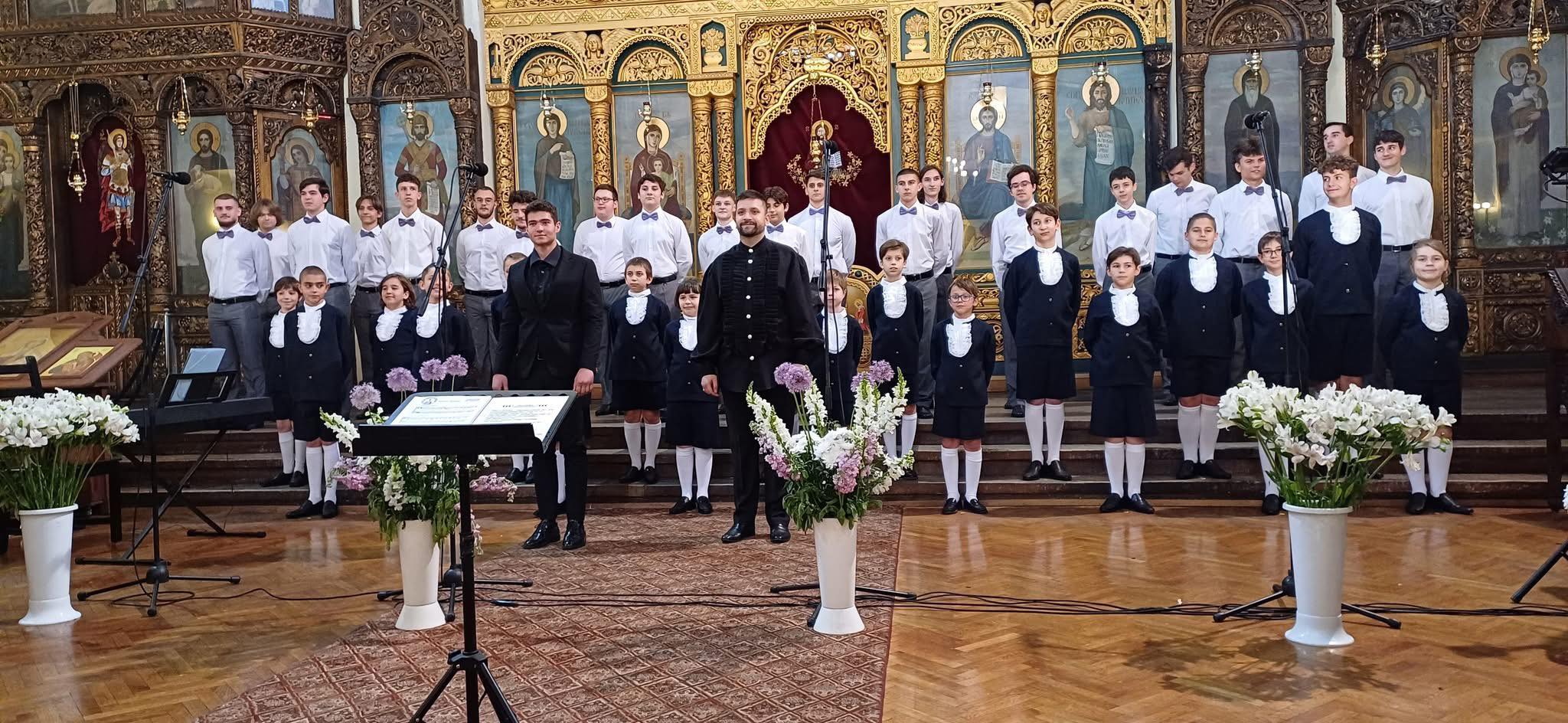
On May 11, the latest Easter concert of the Sofia Boys’ Choir took place, for the first time without its conductor and public face, Prof. Dr. Adriana Blagoeva, who for many years had built the choir’s reputation in Bulgaria and abroad through her exceptional professionalism. Before these boys, orphaned by the loss of their extraordinary conductor and teacher—not only in high musical art but in life itself—a sudden challenge arose: should they continue her work, or should each take his own path? Knowing the situation from within, I can attest that some boys had considered leaving the choir while Prof. Dr. Blagoeva was still alive. Yet a miracle occurred, in the true sense of the great Easter joy. Spirit triumphs over flesh and matter. Much like the story from the Patericon, where a son redirects his father away from alcohol not in this world but from the next, the boys devoted themselves to their teacher, who now resides in the beyond rather than this world.
The concert opened with “Hristos voskrese” (“Christ is Risen”) by Alexander Rozhnov (1821–1878). Recalling the high level of professionalism instilled by Prof. Dr. Blagoeva—including precise intonation, dynamics, sound balance, dramaturgical shaping, and more—it is impossible not to recognize the challenge faced by conductor Alexander Mitev in continuing her legacy, striving for ever-greater artistic heights. History shows that students of great masters often remained in their mentors’ shadow or assimilated fully into their style; yet some surpass their teachers. In this Easter concert, Alexander Mitev undoubtedly demonstrated that he continues Prof. Dr. Blagoeva’s tradition of high-level choral art, while also asserting his own conducting identity, thereby shaping a new sound and character for the Sofia Boys’ Choir.
Objectively, the situation must be considered. Training young children online during the COVID pandemic requires exceptional pedagogical skill. Furthermore, due to the concealment of her terminal illness—a profound act of courage in the Orthodox sense—no one at the time fully understood the severity of Prof. Dr. Blagoeva’s condition. Concerts were thus reduced to shorter programs with briefer pieces, many performed by the youth group without the younger boys. This inevitably affected performance quality, yet not as a dramatic decline, rather as a subtle indication of a new beginning under new circumstances.
From the very first piece of the Easter concert, the full professional artistry of the Sofia Boys’ Choir was apparent, thanks to conductor Alexander Mitev, alongside his team of choirmasters Evelina Kulinski and Olga Menzel, and repetiteurs Mihail Srebrev and Elvis Vasilev. In eager anticipation of hearing the choir again, the audience was not disappointed; rather, we were gifted with new impressions, expectations, and hope for a fresh beginning, one that builds upon Prof. Dr. Blagoeva’s established legacy. The choir displayed the same brilliant cohesion, pure intonation, and balanced dynamics, but now imbued with fuller, uplifted expressions of genuine Easter joy—as if, in the great hope of resurrection, we invisibly rejoice that Prof. Dr. Blagoeva lives in another world, and that death cannot claim absolute dominion over us.
The next piece was “Da izpravytsya molitva moya” (“Let My Prayer Arise”), an Eastern chant with the first voice originally intended in neumatic notation for male singing. Its essence is entirely distinct from Western notation and musical practice, despite revolutionary attempts by some to adapt it to the Western five-line system. Nevertheless, the Sofia Boys’ Choir, now performing in the youth group corresponding to a male choir under Alexander Mitev, conveyed not just a formal singing of a melody, but a deeply contemplative, almost prayerful state, reflecting the conductor’s mastery and the choristers’ skill.
The following piece, “Edin svyat, edin Gospod” (“One World, One Lord”) by Vasily Orlov (1858–1901), along with the remaining works until the end of the concert, showcased the texture of a four-part male choir in the style of Russian choral singing, developed in the late 17th century as an analogue to original Eastern chant. The specificity of choral tradition in liturgical singing was fully realized thanks to Alexander Mitev’s profound understanding and control of ecclesiastical choral technique. Notably, this concert program consisted entirely of Orthodox chant, unlike Prof. Dr. Blagoeva’s concerts, which included works from other denominations.
In the next piece, “Slava v vyshnikh Bogu” (“Glory to God in the Highest”) from Shestopsalmiye (“Six Psalms”) by Yakov Chmelov (1877–1944), the opening of the so-called Great Doxology is presented, sung or read at Matins, composed from selected verses of the six psalms. Here, a liturgical chant from the Great Doxology is combined with polyphonic imitative passages in the Western style—a balance that must be precisely executed by conductor and choristers to convey the composer’s intent. Alexander Mitev demonstrated exceptional skill and competence in this regard.
Next, “Blagoslovi dushe moya Gospoda” (“Bless the Lord, O My Soul”) by Ivan Flegmenko begins with Psalm 102. Rendered as an antiphon from the Divine Liturgy, it is a liturgical chant adapted into a choral arrangement with abridged text. Such dual-layered interpretation requires careful attention from both conductor and choir, successfully achieved here, including the management of vocal ranges and dynamic contrasts.
The following piece, “Dnes vsyaka tvar” (“Today All Creation”), an Easter concert piece by Stepan Dektyaryov (1766–1813), features the refrain after the ninth song of the Paschal Canon, central to the Easter service. As a “concert Easter piece,” it is composed for performance rather than liturgy, respecting ecclesiastical stylistic norms while emphasizing virtuosic, celebratory singing over liturgical pacing. Alexander Mitev expertly conveyed this interpretation to the choir.
“Da izpravytsya molitva moya” (“Let My Prayer Arise”) by Dmitry Bortniansky (1751–1825) is the choral analogue of the Eastern chant from the second piece of the program, traditionally sung at Vespers. Although more of a choral song than a strict liturgical chant, it evokes a prayerful spirit calling to God—a nuance carefully realized by Mitev in tempo, dynamics, and stylistic balance between secular and liturgical elements.
“Vo tsarstviye Tvoyem” (“In Thy Kingdom”) by Dobri Hristov (1875–1945) represents a pinnacle of the concert, one of the most beautiful choral pieces in Orthodox music, designed for concert performance rather than liturgical use. Its success owes to Alexander Mitev, the Sofia Boys’ Choir, and soloist Tanya Lazarova. Through this work, the composer’s devotional intent is vividly conveyed—a spiritual essence that could not be felt without skilled performers. The choir and conductor achieved this with remarkable subtlety, enhanced by the acoustics of the Orthodox Church of St. Paraskeva.
“Dostoyno yest” (“It is Truly Meet”) by Petar Dinev (1889–1980) adapts the eight-voice Eastern chant tradition for choral performance. Dinev, deeply familiar with the tradition yet appreciative of Western musical developments, integrates Western homophonic thinking with remnants of monodic Eastern chant. Mitev’s interpretation masterfully balances Western and Eastern sonorities while preserving the liturgical character.
The final program piece, “Khvalite Gospoda s nebes” (“Praise the Lord from the Heavens”) by Pavel Chesnokov (1877–1944), part of the hymns at the end of Matins preceding the Great Doxology, is rendered as a concert work. Here, Mitev positioned it as a concluding piece, creating a ceremonial praise of God from the entire universe, with particular emphasis on the Old Testament text. This interpretation was powerfully realized by the choir, showcasing skill in intonation, dynamic control, polyphonic passages, and vocal range management. Comparisons with previous performances under Prof. Dr. Blagoeva demonstrate that the Sofia Boys’ Choir now sounds like a fully matured male choir, honoring and continuing her legacy.
Finally, as an extraordinary encore, the concert concluded with “Mnogaya leta” (“Many Years”), in which the audience participated. This was not a superficial gesture; it reflected genuine engagement, shared joy, and the hope that Prof. Dr. Adriana Blagoeva’s great work continues.