Photo: Archive of the Sofia Boys’ Choir
Author: Ema Ivanova
Prof. Adriana Blagoeva: Choral work nurtures both musical and personal qualities
Interview with Prof. Adriana Blagoeva by Ema Ivanova, Treta vazrast newspaper.
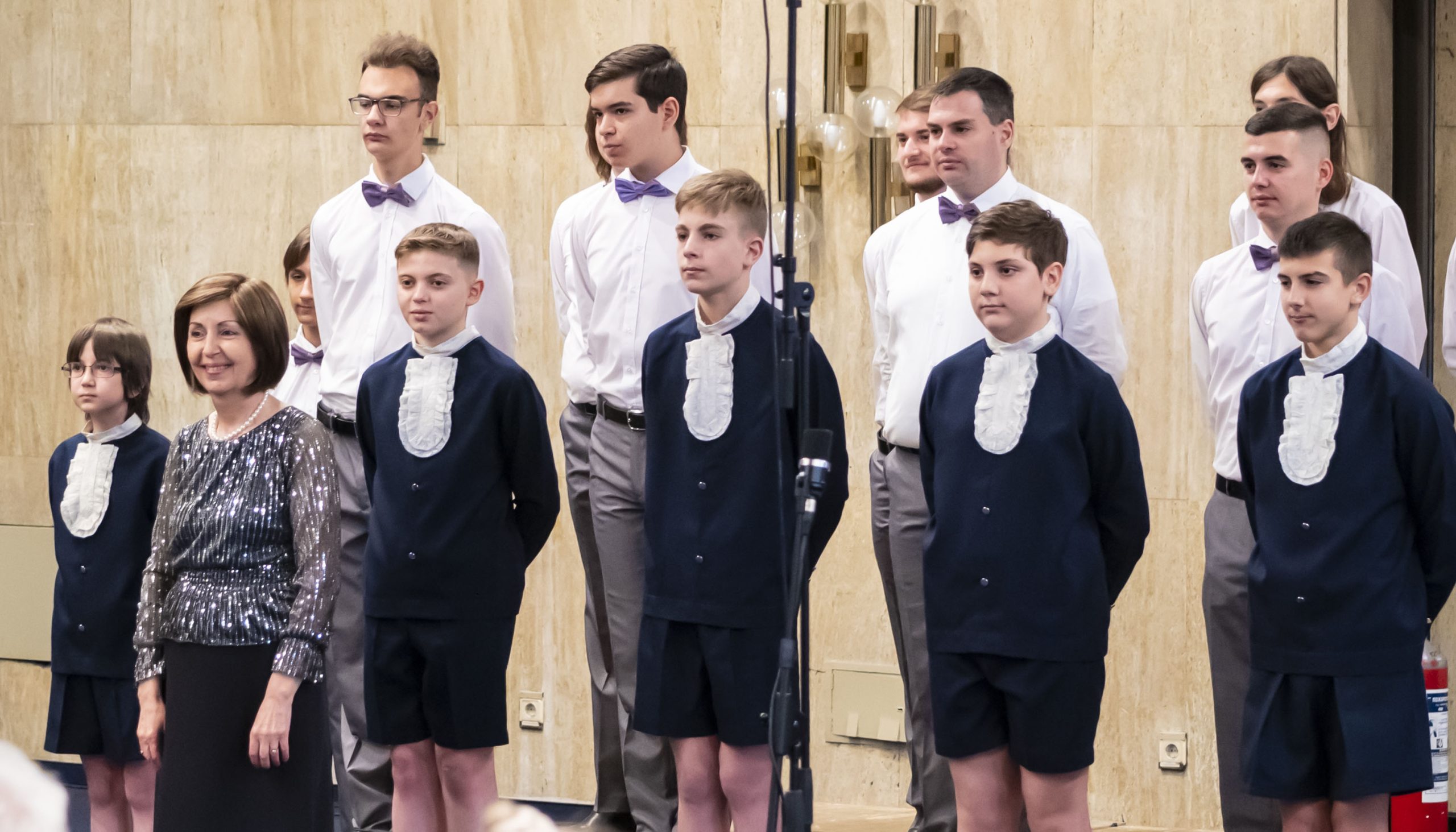
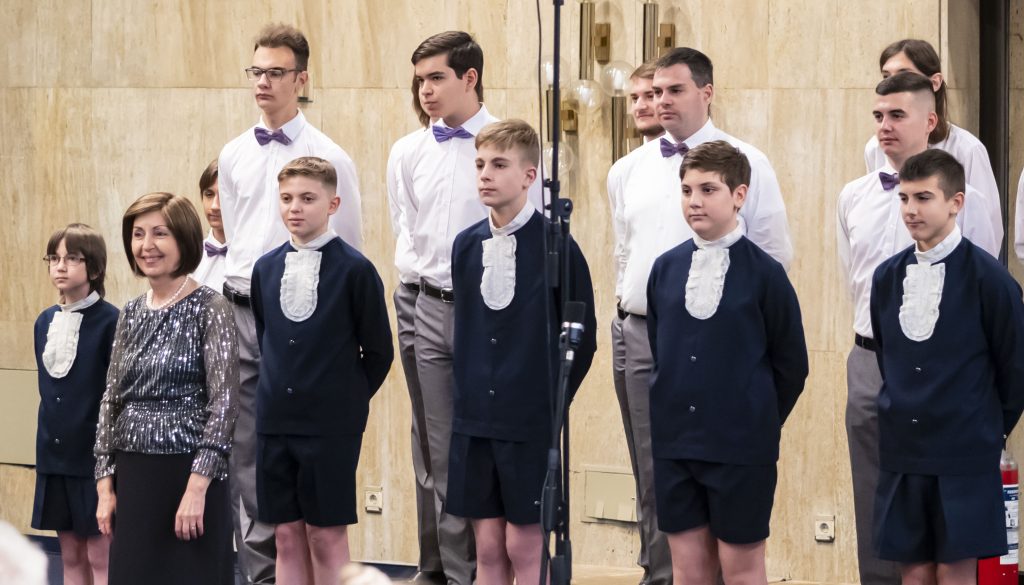
The first boys’ choir in Bulgaria – the Sofia Boys’ Choir – has turned 55.
Adriana Blagoeva was born in Sofia. She graduated from the National Academy of Music “Prof. Pancho Vladigerov” with a major in choral conducting in the class of Prof. Ana Belcheva. She began her career as conductor of children’s, women’s, and mixed choirs in Samokov and Shumen. Since 1988 she has been choirmaster, and since 1989 she has been the conductor of the Sofia Boys’ Choir. She is a distinguished professor of choral conducting at the National Academy of Music, Doctor of Musicology and Musical Arts. She has served as Head of the Conducting Department (2012–2016), Dean of the Faculty of Theory, Composition and Conducting (2016–2020), and since 2020 she has been Vice-Rector for Research and Artistic-Creative Activity at the Academy. Her awards include the Special Prize for Conducting Mastery from the First International Choral Competition in Bolzano, Italy (2000); the “Golden Age” Star of the Ministry of Culture for significant contributions to Bulgarian culture and national identity (2018); the “Crystal Necklace” of the Union of Bulgarian Musicians and Dancers, and the Order of Saints Cyril and Methodius, First Degree, for outstanding achievements in culture and the arts (2021).
Tell us a few words about your family—was it what led you to music?
The family environment is very important for everyone. I am extremely grateful to my parents for giving me the opportunity and encouragement to pursue music. My love for music comes from them—they loved music, especially classical music. They were the first to recognize that I needed to study music, and so in the second grade I began playing the piano.
What is special about working in the field of choral music?
Choral music is highly expressive because it is created with the human voice. This has always impressed and attracted me to this art form. My interest in choral music arose spontaneously. When I entered the Academy, I encountered excellent teachers who played a decisive role in shaping me as a musician. I am deeply grateful to my choral conducting professor, Prof. Ana Belcheva. I am also deeply grateful to Prof. Veneta Vicheva—an outstanding choral conductor, pedagogue, public figure, and human being—whom I had the opportunity to work with in Shumen for three years. Communicating with her and working with her wonderful choirs—the children’s choir “Bodra pesen” and the mixed choir “Rodni zvutsi”—was a true professional school for me.
What qualities does your work cultivate in you and in the choristers?
A person must love what they do. Choral work is very demanding. It requires strong work ethic, dedication, goodwill toward the choristers, patience, and inner discipline. One must possess these qualities, but they also develop naturally throughout the working process.
Do you also need to be something of a psychologist?
Not “something”—very much so (laughs). Especially when working with children. Our boys start at the age of 8–9. To integrate them into our choral work, the specific approach is crucial. I try to apply an individual approach to each child. It is very important for the boys to enjoy singing, because the work itself involves effort and learning. Choral work is educational work, and the skills must be well developed before a child is ready to participate in concerts.
How do you explain the development of children’s choral performance today? Almost everything related to children’s education is now paid or in decline…
In recent years, there has been a growing interest in children’s choral singing in its various forms. This relates to the need for concert performance and for showcasing the musical and vocal abilities of children. Choral work greatly contributes to the development of the child’s personality—it cultivates not only musical skills but also personal qualities such as diligence, discipline, teamwork, collegiality, and empathy. These qualities help a child grow into a well-rounded individual. Through the choir, children are exposed to a wide range of musical works, styles, and genres, and they also form friendships that often last a lifetime.
The Sofia Boys’ Choir is celebrating its 55th anniversary. Under your leadership, it has achieved its greatest successes: expanding its repertoire, increasing its concert and recording activity, and winning prestigious international awards. What makes you so successful and sets you apart from other choirs?
This is the first boys’ choir in Bulgaria, founded in 1968. Over the years, the choir has established several traditions, such as our Christmas and Easter concerts.
Our ensemble has an active recording career—since 1993 we have released 12 solo CDs and one DVD. We have also participated in eight other CDs in collaboration with various performers. This is exceptionally intensive recording activity for a choir, especially a children’s choir.
We have received one Grand Prize, six First Prizes, and five Second Prizes from eight international choral competitions. This is a significant international achievement for the Sofia Boys’ Choir, which actively promotes Bulgarian music and musical culture.
On November 1, 1997, a youth formation was created consisting of former members of the boys’ group. This allows us to perform with three ensembles—boys’, youth, and mixed—which further enriches our repertoire and concert programs.
Another factor that distinguishes us is the high recognition we have received for our concert work. The choir has been awarded the “Silver Lyre” (1998), the “Golden Lyre” (2003), and twice the “Crystal Lyre” (2009 and 2012), the highest professional award for music in Bulgaria. We have twice received the “Golden Feather” award. The choir has also been honored with the Honorary Badge of Sofia Municipality, the Honorary Plaque of the Ministry of Culture for outstanding artistic achievements, the Golden Plaque of the Bulgarian Choral Union, and was named “Musician of the Year” in 2002 in the category “Active Creative Activity” in the “Allegro vivace” rankings of Bulgarian National Radio. Particularly valuable to us is the special church order “St. John Koukouzel,” awarded by the Holy Synod of the Bulgarian Orthodox Church for our contribution to the dissemination of Church Slavonic music.
Church Slavonic music holds a central place in your repertoire, which also includes music from different eras and styles. How do children and young people of the 21st century perceive it?
Church Slavonic music is very beautiful and deeply expressive in performance. It is not perceived strictly as religious music, but rather as music that carries a specific message and beauty. The children perform it with great enthusiasm—we have recorded three CDs of it. We always promote this repertoire during our tours abroad. Alongside it, we perform Catholic liturgical music, contemporary sacred works with a concert character, arrangements of Bulgarian folk songs, children’s choral music by Bulgarian and foreign composers, and choruses from operas and musicals.
You have performed with the men’s choir “Kaval,” the Sofia Philharmonic and its National Philharmonic Choir “Sv. Obrucheniov,” the choir and orchestra of the National Opera, the orchestra and mixed choir of Bulgarian National Radio, the New Symphony Orchestra, and others. You have also participated in productions at the State Musical Theatre, the Youth Theatre, and the National Opera… This is an enormous amount of work. How do you rest?
Like everyone else. I love spending time with my family—in the mountains, at the seaside. Simply a normal life. During the month or so when I take a break from choral work, I think about what comes next. I use that time to reflect on new ideas and possibilities for our ensemble.
What will you perform at your concert on June 18 in Hall 6 of the National Palace of Culture, which is part of the Sofia Music Weeks?
The program will include a wide variety of works—pieces that summarize the activities and development of our choir over the past 55 years. We have included works by both Bulgarian and foreign composers, and there will be some musical surprises for the audience.