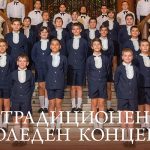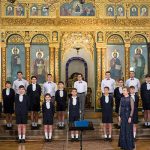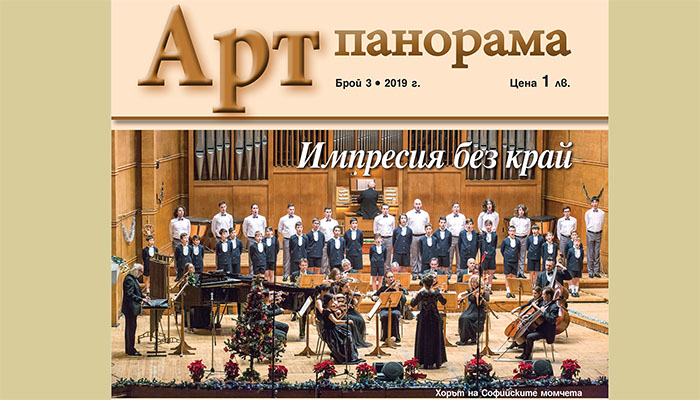
30th Traditional Christmas Concert, December 25, 2018, Bulgaria Hall
Art Panorama Magazine, Issue 3/2019
Emilia Kolarova
An Endless Impression
The history of the Sofia Boys’ Choir is both remarkable and profoundly compelling. It impresses with the breadth of its artistic activity over the fifty years since the ensemble’s founding; with the vitality and affirmative spirit conveyed through hundreds of concerts; with the unwavering dedication of its conductor and choristers, who today jointly uphold an unqualified mission: the advancement of contemporary Bulgarian musical culture. It is astonishing how this chronicle quietly yet decisively defies one of nature’s most immutable laws — that every story, even the most beautiful, must have both a beginning and an end.
The Sofia Boys’ Choir at the “Tsar Boris III – 1928” Community Centre has been blessed with the rare privilege of developing and offering its art to the world for half a century. My reflections are prompted by a concert long past, yet one that continues to inspire me — not only as a brilliant artistic achievement but also as a symbol of a firmly established and successfully sustained national tradition. On 25 December 2018, the Choir’s Christmas Concert at Bulgaria Hall marked the 30th anniversary of this beloved tradition. I ask myself: what conviction in the meaning of this annual celebration must guide the conductor and choristers as they continue to reveal to the public the moral beauty of the Nativity through music? And what rigorous rehearsal work precedes such a deeply rooted tradition? My conversation with the Choir’s conductor, Prof. Dr. Adriana Blagoeva, offers answers to all these questions. Here, I should add another important anniversary: in 2019, it was thirty years since A. Blagoeva assumed the artistic leadership of the ensemble.
In a season of such emblematic milestones, statistics serve as a reliable guide. The beginning was laid in 1968 by Lilyana Todorova, who founded the first boys’ choir in Bulgaria. Over its uninterrupted fifty-year history, more than 2,500 children, aged 8 to 15, have sung in its ranks. Today the ensemble comprises three formations: a boys’ choir, a youth formation (established in 1997 and consisting solely of former choristers), and a mixed choir. Their repertoire spans works from the 14th to the 21st century. Under the baton of Prof. Adriana Blagoeva, a substantial number of Bulgarian premieres of works by Bulgarian and international composers — many written especially for the choir — have been realized. Since 1993, the ensemble has released 11 solo CDs, in addition to participating in 8 collaborative recordings. Choristers appear in productions of the National Opera and Ballet, the Stefan Makedonski Music Theatre, and the N. Binev Youth Theatre; and they collaborate with the orchestras of the Sofia Philharmonic, the Bulgarian National Radio, Classic FM Radio, the National Opera and Ballet, and the New Symphony Orchestra, under the direction of renowned conductors including Ivan Marinov, Georgi Dimitrov, Alipi Naydenov, Emil Tabakov, Rosen Milanov, Nayden Todorov, Yordan Dafov, and Luciano di Martino. They have performed with such distinguished artists as Anna Tomowa-Sintow, Hristina Angelakova, Tsvetana Bandalovska, Ina Kancheva, Nikolay Motsov, and Atanas Atanasov.
The Choir has toured with great success in Russia, Serbia, Greece, Poland, Germany, Italy, Spain, France, Slovenia, Slovakia, Moldova, Hungary, Bosnia and Herzegovina, Switzerland, Belgium, Turkey, Romania, and Japan. Since 1993, the ensemble has received 11 awards from seven international choral competitions — one Grand Prize (Arezzo, 1993), five First Prizes, and five Second Prizes. It was the first Bulgarian choir to earn the right to compete for the European Grand Prix for Choral Singing (Tolosa, 1994); the first Bulgarian participant in the festival of laureate choirs in Vaison-la-Romaine, France (1995); and the only Bulgarian representative included in the European Union’s anthology “We Are the Future” (2014). Nationally, the Choir has been honoured with the Silver, Golden and Crystal Lyre of the Union of Bulgarian Musicians and Dancers; the Golden Feather award; the Bulgarian National Radio’s “Musician of the Year – 2002” prize for “Active Artistic Activity”; honorary plaques from the Bulgarian Choral Union, the Ministry of Culture, and the Union of Bulgarian Composers; the Honorary Badge of Sofia Municipality on the occasion of its 50th anniversary; and the Order of Merit “St. Ioan Koukouzel – the Angel-Voiced” from the Holy Synod of the Bulgarian Orthodox Church. For her long-standing work with the Choir, Prof. Adriana Blagoeva has been distinguished with the Golden Lyre, and in 2018 received the Ministry of Culture’s “Golden Age” – Star award for her significant contribution to Bulgarian culture and national identity.
Statistics, however, can only hint at the Choir’s intense concert and recording activity, its competition victories and triumphs. They cannot reveal the intricate mechanisms of preparation nor the daily rigour of the rehearsal process. Only a conversation with Prof. Blagoeva brings these essential, often invisible elements into focus.
In this choir, tradition is elevated to a principle.
There is a tradition of working tirelessly, regardless of the artistic heights already achieved. Work with a boys’ choir carries its own distinct challenges, shaped by the short performing lifespan of pre-adolescent voices. The natural process of vocal maturation limits a chorister’s active participation to approximately six or seven years. To make the most of this period, Prof. Blagoeva carefully observes and selects children from Sofia schools. Those who show both desire and aptitude for singing enter preparatory and trainee groups. They undergo two years of separate musical training, and — with demonstrated responsibility, discipline, patience, and perseverance — have the opportunity to join the concert ensemble. In 1997, responding to the natural need for continuing musical development among graduated choristers, the Youth Formation was established. This, in turn, enabled the creation of a mixed choir, significantly expanding the ensemble’s artistic and repertoire possibilities. The fluid transition between age groups is made possible by a unified set of pedagogical and artistic principles applied across all three formations. Thus, a system emerges which, through continuity and progression, cultivates a deep sense of ensemble musicianship in young performers.
The periodic and inevitable renewal of the ensemble motivates the conductor to preserve the Choir’s finest artistic achievements. For this reason, its recording activity is a strategic priority, pursued with persistent focus and purpose. As a result, the Choir has released 11 solo albums, capturing the ensemble’s most distinguished accomplishments from the past three decades of concert life.