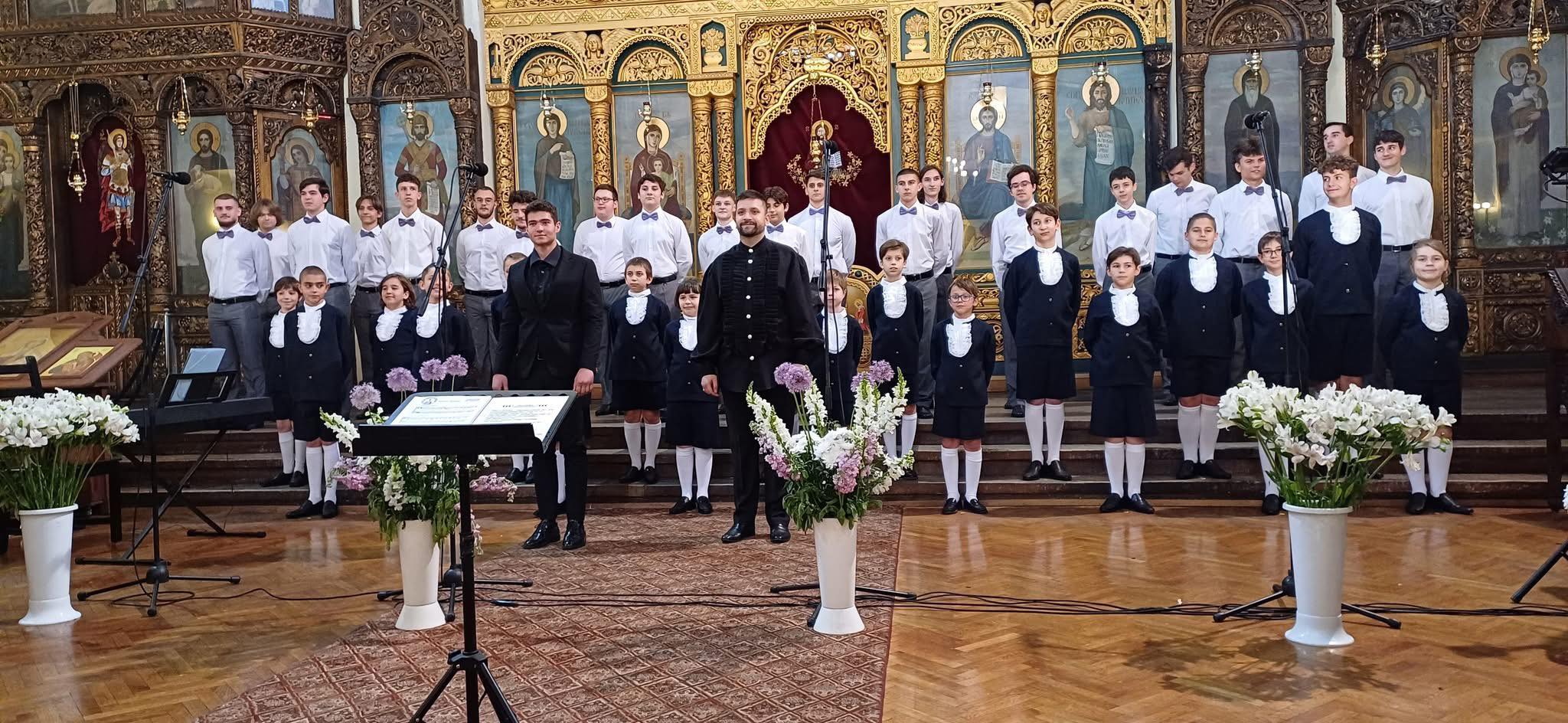
“Easter Concert of the Sofia Boys’ Choir,”
by Prof. Dr. Andrey Diamandiev, composer and faculty member at the National Music Academy “Prof. Pancho Vladigerov”.
Electronic publication Musical Logos, ISSN 2534-8973
September 2025
Easter Concert of the Sofia Boys’ Choir
On 11 May, the Sofia Boys’ Choir presented its traditional Easter concert—an event of profound symbolic and artistic significance—unfolding for the first time without its long-standing conductor and defining artistic presence, Prof. PhD Adriana Blagoeva.
For decades, through uncompromising professionalism and visionary leadership, she had shaped the choir’s artistic identity and firmly established its reputation both in Bulgaria and on the international stage.
Before these young singers—suddenly bereaved of their exceptional conductor, mentor, and moral guide in the highest art of choral singing and in life itself—there arose a deeply existential question: whether to carry forward her legacy or to part ways, each pursuing his own path. As one who knows the ensemble’s inner reality, I can attest that even during Prof. PhD Adriana Blagoeva’s lifetime, some of the boys had contemplated withdrawing from the choir. And yet, a miracle occurred—one that resonates fully with the essence of Paschal joy. Spirit triumphed over flesh and matter. As in the Paterikon, where a son redeems his father from vice not from this world but from the next, the boys dedicated themselves to their teacher, who now belongs not to this world, but to the eternal one.
The concert opened with „Hristos voskrese“ (Christ Is Risen) by Alexander Rozhnov (1821–1878). Recalling the extraordinarily high artistic standards cultivated by Prof. PhD Adriana Blagoeva—immaculate intonation, refined dynamic control, sonic balance, and a deeply considered dramaturgical arc—one cannot but recognize the immense responsibility now resting upon conductor Alexander Mitev. His task is not merely to preserve her achievements, but to continue elevating them toward ever greater artistic heights. History teaches us that disciples of great masters often remain eclipsed by their teachers’ stature or dissolve entirely into inherited stylistic frameworks; yet there are also those who transcend their lineage. In this Easter concert, Alexander Mitev demonstrated beyond doubt that he both faithfully continues Prof. PhD Adriana Blagoeva’s tradition of excellence and asserts a distinct artistic voice of his own—thereby shaping a renewed sonic identity for the Sofia Boys’ Choir.
There is, of course, an objective historical context to acknowledge. The training of young children through online platforms during the COVID period constituted an act of pedagogical mastery of the highest order. At the same time, the concealment of a terminal illness—an act of great spiritual fortitude in the Orthodox understanding—meant that few were aware of Prof. PhD Adriana Blagoeva’s true condition. Concert activity was necessarily reduced, programmes shortened, and performances often limited to the youth ensemble. While this affected artistic continuity, it did not signify decline, but rather foreshadowed a transition toward a new and uncertain chapter.
Against this backdrop, the very first work of the Easter concert revealed unmistakably the hallmarks of the Sofia Boys’ Choir’s mature artistic excellence, now restored in its full formation. This achievement is owed not only to Alexander Mitev’s leadership, but also to the devoted work of his artistic team: choirmasters Evelina Kulinski and Olga Mentzel, and répétiteurs Mihail Srebrev and Elvis Vasilev. What followed was not merely a return, but a renewal—marked by the choir’s characteristic unity, purity of intonation, and balanced dynamics, now infused with a fuller sonority and an elevated sense of authentic Paschal joy. It was as though, in the radiant hope of the Resurrection, the audience sensed both that Prof. PhD Adriana Blagoeva lives on in another realm and that death itself does not possess ultimate dominion.
In „Da ispravitsya molitva moya“ (Let My Prayer Be Set Forth)—an Eastern chant originally notated in neumatic (psaltic) script and conceived for male voices—the choir confronted a musical language fundamentally distinct from Western notation and aesthetic logic. Under Alexander Mitev’s direction, the youth ensemble rendered not merely a melodic line, but a state of prayerful contemplation marked by inward concentration and spiritual depth—testimony to both refined conducting insight and the singers’ artistic maturity.
With „Edin svyat, edin Gospod’“ (One World, One Lord) by Vasily Orlov (1858–1901), the programme moved decisively into the realm of four-part male choral writing in the Russian sacred tradition. Here, the conductor’s profound understanding of the Orthodox choral idiom became fully apparent, allowing the choir to unfold the style’s monumental breadth and inner intensity. Notably, the programme was devoted entirely to Orthodox chant—an intentional departure from the ecumenical repertoire characteristic of Prof. PhD Adriana Blagoeva’s concerts.
In „Slava v vyshnih Bogu“ (Glory to God in the Highest) from the Shestopsalmiye by Yakov Chmelyov (1877–1944), liturgical chant merges with Western-inspired polyphonic imitation. The precision required to balance these idioms was met with stylistic clarity and expressive restraint, revealing Alexander Mitev’s assured command of complex sacred textures.
The antiphonal psalm setting „Blagoslovi, dushe moya, Gospoda“ (Bless the Lord, O My Soul) by Ivan Flegmenko presented a further stylistic duality, combining liturgical function with concert realization. Despite challenges of tessitura and dynamic amplitude, the choir achieved a convincing synthesis of reverence and musical projection.
A climactic moment arrived with „Dnes vsyaka tvar’“ (Today All Creation Rejoices)—a Paschal concerto by Stepan Degtyaryov (1766–1813). Interpreted in its proper concert spirit rather than as liturgical chant, the work radiated jubilation and brilliance, celebrating the Resurrection with virtuosic clarity and rhythmic vitality.
The contemplative dimension returned in „Da ispravitsya molitva moya“ (Let My Prayer Be Set Forth) by Dmitry Bortniansky (1751–1825), where Alexander Mitev shaped a finely balanced interpretation, poised between devotional introspection and concert expressivity.
With „Vo tsarstviĭi Tvoem“ (In Thy Kingdom) by Dobri Hristov (1875–1945), one of the most exquisite achievements of Orthodox choral literature, the concert reached a spiritual and artistic summit. Joined by soloist Tanya Lazarova, the choir conveyed a profound sense of prayerful exaltation, further magnified by the resonant acoustics of the Church of St. Paraskeva.
In „Dostoyno est“ (It Is Truly Meet) by Petar Dinev (1889–1980), Eastern monodic sensibility and Western homophonic thinking coexist in a carefully negotiated balance, masterfully realized through Alexander Mitev’s stylistic discernment.
The programme concluded with „Hvalite Gospoda s nebes“ (Praise the Lord from the Heavens) by Pavel Chesnokov (1877–1944), a majestic hymn of praise that crowned the concert with solemn grandeur, despite formidable technical demands.
As a final gesture, the choir and audience united in „Mnogaya leta“ (Many Years)—not as a formal encore, but as a shared act of collective joy, remembrance, and hope. In that moment, it became unmistakably clear: the great artistic and spiritual legacy of Prof. PhD Adriana Blagoeva not only endures—it continues to grow.
Prof. Dr. Andrey Diamandiev