Musical Horizons Magazine, Issue 8/2015
Yavor Konov
From July 7 to 12, 2015, the third edition of the Çanakkale Choir Festival — held biennially since 2011 — took place in the city of Çanakkale, Turkey, with great success. The festival is affiliated with 18 March University in the city (Çanakkale Onsekiz Mart Üniversitesi), a large, modern, and well-equipped university founded in 1992, currently hosting around 44,000 students across 13 faculties, 4 institutes, 8 colleges, 13 vocational schools, and 26 research and applied centers.
The festival featured 30 choirs, 29 of which were Turkish, coming from cities including Çanakkale, Istanbul, Ankara, Mersin, Bolu, Adana, Denizli, Isparta, Trabzon, Cyprus, Burdur, Samsun, and Tekirdağ. Among them were not only very good choirs but also outstanding ones, both university and other types. (You can view some clips here: Clip 1, Clip 2, Clip 3).
The initiator, main organizer, and true “soul” of the festival is Turkish choral conductor Mete Gökçe (born in 1975 in Ankara, now based in Çanakkale), who conducted three choirs at the festival: Konrul Vocal Ensemble, Çanakkale Barış Korosu, and 100 Ses Gençlik Korosu. He is a conductor with not only precise manual technique but also artistry, charm, suggestive power, and stage presence, occasionally even a touch of “panache” in his communication with choirs and audiences. Mete Gökçe is a faculty member at 18 March University and enjoys genuine popularity and affection from students, choristers (both his own and visiting), and audiences alike. He is currently pursuing a PhD in the Department of Music at New Bulgarian University under the supervision of Prof. Dr. Adriana Blagoeva and Prof. Dr. Yavor Konov.
At the festival, Mete Gökçe also presented his charming children’s choir, Çanakkale Hüseyin Akif Terzioğlu Ortaokulu Çocuk Korosu, with very attractive uniforms, accompanied by Ebru Gökçe, his wife.
All concerts of the Çanakkale Choir Festival (free of charge) were held in the large university hall (seating 1,500), in the newly built 2014 University Congress Center. Each choir, according to festival regulations, was also required to perform an outdoor concert in the city center.
The festival opened on the evening of July 7 along the spacious seaside promenade of Çanakkale (near the ancient Troy model and the wooden horse from the 2004 film Troy), with chairs, excellent lighting, and sound design. A highlight was the opening performance of “O Fortuna!” from Carl Orff’s Carmina Burana, sung in Turkish, accompanied by spectacular multicolored fountains in the sea, synchronized in number, type, direction, and intensity, with color-changing water jets.
Çanakkale (from “Çanak Kalesi,” meaning “pottery fortress,” an old pottery center) is a port city on the Asian side of the Dardanelles (Hellespont) and the administrative center of the eponymous province — Turkey’s westernmost, spanning two continents, opposite the city of Gallipoli (Gelibolu). The two continents are connected by ferry. The city has a beautiful historic center as well as expanding modern districts.
One of the festival’s particularly commendable features is its non-competitive character, which prevents rivalry, envy, or ill will from arising. Conflicts that often occur at competitive festivals — among conductors or choristers over jury decisions — are avoided here, creating a friendly, collegial, and supportive environment. I was also impressed by the festival’s organization and the dedicated involvement of student volunteers, who participated with visible joy and satisfaction.
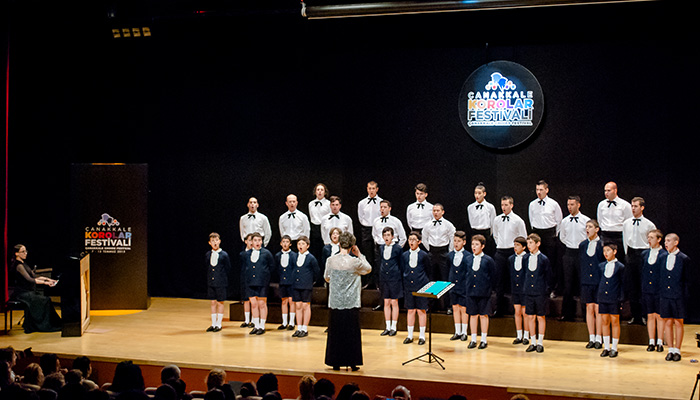
The only foreign choir invited to the festival was the Sofia Boys’ Choir, conducted by Prof. Dr. Adriana Blagoeva, who gave the gala concert — the evening’s highlight. (Had they performed a popular Turkish song, the audience reaction would have been unstoppable, perhaps even lifting them onto their shoulders!) The choir’s performances are always polished, confident, and delicately presented. Prof. Blagoeva arranged her program masterfully in two halves: the first showcased Bulgarian choral artistry — both compositionally and in performance — accompanied by a screen displaying beautiful images of Bulgaria’s nature, architecture, and landmarks.
Prof. Blagoeva was accompanied by the superb accompanist Zornitsa Getova, a pianist of virtuosity and artistry, capable of evoking the sound of an entire orchestra. She possesses the subtle skill of providing sensitive, supportive accompaniment, enhancing both choir and conductor. Together, Blagoeva and Getova form a partnership that is both reliable and highly expressive.
From the moment the Sofia Boys’ Choir appeared on stage, their confidence and experience were evident. The choristers knew their capabilities, were aware of what they were performing and how, and radiated joy at the anticipated success of the performance — shared by both audience and performers. The same impression applied to their conductor.
I attended all festival concerts and was delighted by the enthusiastic reception and prolonged applause for the Sofia Boys’ Choir in the packed hall. Notably, the atmosphere of the festival was free of envy, characterized by collegial joy, shared appreciation, and mutual support. This was evident in applause, audience singing along, and combined choir performances, sometimes with choristers conducting or joining other choirs.
I heard many beautiful Turkish folk-inspired choral arrangements, such as Dostluğa Davet and Suda Balık Oynuyor, arranged by Turkish composer and pedagogue Erdal Tuğcular (b. 1961), originally performed by Çanakkale University Choir conducted by Mete Gökçe (2011 recordings: Clip 1, Clip 2). The audience appreciated both the “original” folk melodies and their choral adaptations. I also enjoyed works from Western European and global choral repertoires, including sacred Christian compositions. Many choirs performed without the stiffness often seen elsewhere, demonstrating genuine joy and freedom on stage.
Notable young Turkish conductor Massis Aram Gözbek (b. 1987), a multiple gold-medal winner at international choral competitions, conducted the Boğaziçi Gençlik Korosu (Bosphorus Youth Choir) and Boğaziçi Caz Korosu (Bosphorus Jazz Choir) at Boğaziçi University, a top-ranked Turkish university teaching in English. The university is the successor of the famous Robert College in Istanbul, historically significant for Bulgarian education and the national revival.
In 2013, the previous festival invited the Bulgarian Radio Children’s Choir, conducted by the late academician Hristo Nedyalkov, for a highly successful concert (video).
The absence of foreign choirs at Çanakkale reflects the organizers’ intent: the festival is not an international forum but a central event for choral life in Turkey. Not all Turkish choirs participate; a search for “korosu” or “Korolar Festivali” online shows other choral competitions across Turkey in Istanbul, İzmir, Antalya, and Pamukkale.
The festival also featured a professional and highly competent host, likely a television presenter, whose diction, cultural awareness, and stage presence contributed significantly to the festival’s smooth and elevated proceedings. Her expressive delivery highlighted the many nuances of the Turkish language, even when I could not understand the words.
Special attention was given to Turkish conductor and music educator Adnan Atalay (b. 1952), whose works and arrangements were performed during the concerts. On July 8 at 6 p.m., he delivered a conference on choral art.
The programs also included charming mime performances by students from the Istanbul Technical University Conservatory. Information in English was limited, so at times I wished I knew more Turkish to fully follow the festival.
I observed modern, open-minded Turkish students, confident and fluent in English, some wearing minimal clothing without it being a distraction — a testament to their openness and self-assurance.
I could also write about the remarkable hospitality of the Turkish people, excellent roads, and the peace and security we experienced throughout the country. Of course, Turkey is vast and diverse, with a wide variety of people in different regions — I share these observations without idealizing. I would also like to write about Troy, about 30 km from Çanakkale, which we visited.
But I will stop here.